 Email
Email  Linkedin
  WhatsApp
  Print/PDF
 2-2021-1574
Plant-Derived Non-CG Epigenetic Editor for Human Cells
A plant-derived epigenetic editing platform that introduces non-CG methylation into human cells. PpDNMT3 creates methylation features also found in neurons and modulates gene expression, expanding the epigenome space available for engineering and disease research.
UNMET NEED
- DNA methylation is a central mechanism controlling gene expression and cell identity.
- In most human cells, methylation occurs mainly at CG sites, limiting the genomic regions accessible to methylation-based regulation.
- Non-CG methylation is prominent in neurons and embryonic stem cells and contributes to neuronal gene regulation.
- New tools are needed to introduce non-CG methylation in additional cell types to study, manipulate, and potentially repair abnormal gene-expression programs.
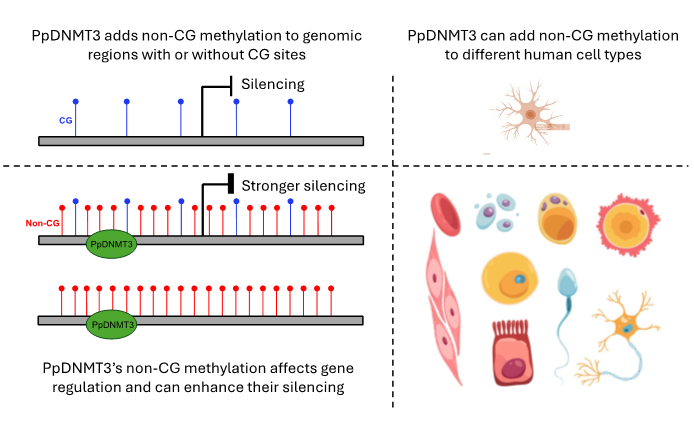
OUR SOLUTION
Using the moss DNA methyltransferase PpDNMT3 to induce non-CG methylation and regulate gene expression in human cells.
Published supporting data:
- PpDNMT3 induces robust, genome-wide non-CG methylation in HEK293/HEK293T human cells.
- Non-CG methylation reaches levels comparable to human neurons and embryonic stem cells, with a similar preference for CAC sites.
- PpDNMT3 targets genes, transposons, and genomic regions with few or no CG sites, expanding the addressable epigenome.
- PpDNMT3 alters gene expression; combined CG and non-CG hypermethylation is associated with stronger transcriptional repression.
- The platform can potentially be combined with programmable DNA-targeting systems such as dCas9 for locus-specific epigenome editing.
POTENTIAL FUTURE APPLICATIONS- Manipulation/repair if gene expression for therapeutic purposes
- Targeted epigenome editing: Combine PpDNMT3 with programmable DNA-targeting systems such as dCas9 to regulate selected genes, including at CG-poor regions.
- Neurological disease research: Test neuron-associated non-CG methylation in neuronal models to investigate neurodevelopmental and neurodegenerative disease mechanisms.
- Disease models and cell engineering: Create cellular models with defined epigenetic states and evaluate effects on cell identity and differentiation.
- Functional epigenomics: Test causal effects of non-CG methylation at promoters, gene bodies, enhancers, and repetitive elements.
- DNA mapping and labeling: Explore PpDNMT3-dependent non-CG methylation as a distinctive genomic label for mapping applications.
INTELLECTUAL PROPERTY
Patent application filed: US patent application No. 62/813,805.
REFERENCES
- Yaari R. et al. RdDM-independent de novo and heterochromatin DNA methylation by plant CMT and DNMT3 orthologs. Nature Communications 10, 1613 (2019).
- Domb K. et al. DNA methylation mutants in Physcomitrella patens elucidate individual roles of CG and non-CG methylation in genome regulation. PNAS 117, 33700-33710 (2020).
- Domb R. et al. A plant DNMT3 induces non-CG methylation and affects gene expression in human cells. iScience 29, 117542 (2026). DOI: 10.1016/j.isci.2026.117542.


