 Email
Email  Linkedin
  WhatsApp
  Print/PDF
 ReCag: Reversible Cysteine Masking for Tag-Free, Site-Selective Editing of Multi-Cysteine Proteins
A modular chemical platform that installs a single, precisely chosen modification into proteins bearing multiple cysteines — without engineered tags, directing ligands, or any change to the native amino acid sequence.
SHORT DESCRIPTION
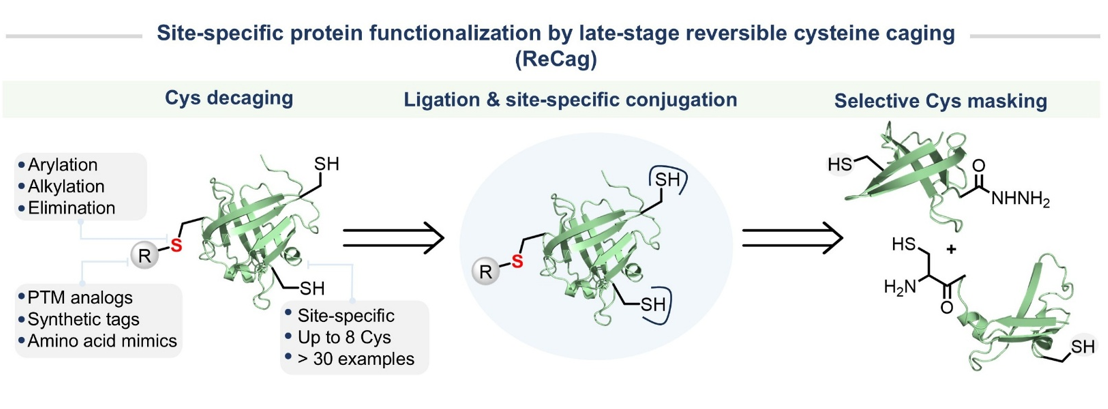
ReCag (Reversible Cysteine Caging) is a synthetic chemistry platform developed at Prof. Muhammad Jbara’s lab, that enables site-selective functionalization of any single cysteine within a protein or peptide that contains several native cysteine residues. The protein is split into two segments; all cysteines except the target site are transiently “masked” with removable protecting groups, the segments are rejoined by native chemical ligation to expose one reactive cysteine, that site is chemically modified, and a final photochemical step unmasks the remaining cysteines — restoring the fully native sequence everywhere except the deliberately modified residue.
UNMET NEED
Cysteine is the preferred handle for site-selective protein bioconjugation (arylation, alkylation, elimination) because of its low natural abundance and distinctive reactivity. However, essentially all current cysteine-based conjugation chemistries were built for proteins with a single reactive cysteine. The moment a protein contains several cysteines — as most natural proteins, zinc-finger transcription factors, and many biologics do — these chemistries lose selectivity and generate heterogeneous mixtures of products.
Existing workarounds (π-clamp motifs, metal-binding sequences, or peptide-ligand-directed recognition) restore selectivity only by inserting an exogenous directing sequence or ligand into the protein, permanently altering its native structure and limiting which proteins and sites can be targeted. Separately, chemical protein synthesis and semisynthesis can access precisely modified proteins, but producing each new analog requires repeating the entire synthesis — a slow and costly bottleneck for building the protein-variant libraries that drug discovery, PTM biology, and protein-engineering programs need.
OUR SOLUTION
ReCag resolves this without touching the native sequence:
- Mask: Internal native cysteines in each protein segment are reversibly caged (N-terminal thiazolidine formation followed by a photolabile 2-nitrobenzyl group), leaving one cysteine free per segment.
- Ligate: The masked segments are joined by native chemical ligation, generating a full-length, natively-sequenced protein carrying a single unmasked, reactive cysteine at the ligation junction.
- Functionalize: That single exposed cysteine is site-specifically modified using standard, broadly compatible chemistries — Pd-mediated arylation, alkylation, dehydroalanine-based elimination/Michael addition, or maleimide chemistry.
- Decage: Mild UV photolysis (350 nm) removes the remaining protecting groups in one step, regenerating all native cysteines and delivering a protein with the wild-type sequence everywhere except the one intentionally installed modification.
Because masking and ligation generate a common synthetic intermediate, that same intermediate can be diversified late-stage into many different analogues — methylation states, phosphorylation and nitro-tyrosine mimics, acetylation, natural amino-acid substitutions, or conjugation to biotin, PEG, a fluorophore, a peptide, or a PROTAC — without repeating protein synthesis for every variant, and even installing two independent modifications at two different sites in the same protein.
UNIQUE ADVANTAGES
- Tag- and ligand-free: no exogenous recognition sequence, metal-binding motif, or directing ligand is introduced — the final product retains the fully native protein sequence.
- True site-selectivity in multi-cysteine proteins: validated on peptides and proteins bearing 3–8 native cysteines, including cysteine-rich Cys2His2 zinc-finger transcription factors.
- One intermediate, many products: a single masked/ligated intermediate is diversified into a broad panel of analogs via late-stage chemistry, avoiding repeated de novo synthesis.
- Broad, proven chemistry scope: compatible with arylation, alkylation, dehydroalanine elimination/Michael addition, and maleimide chemistry, in high conversion (up to 99%) and good isolated yields.
- Dual-site editing: sequential masking/ligation of three segments enables two distinct, independently chosen modifications within one protein.
- Functionally validated: engineered zinc-finger transcription factor analogs generated with ReCag preserved the folded zinc-finger domain (confirmed by CD spectroscopy) and, for three lead analogs, achieved 4- to 6-fold tighter DNA binding (KD of 39–55 nM) than the wild-type protein (KD 234 nM), as measured by EMSA and bio-layer interferometry.
- Solution-phase and modular: the caging chemistry is performed in solution, positioning the platform for future integration with recombinant protein segments and expressed protein ligation to reach larger, intact protein targets.
COMPETITIVE ADVANTAGES
- π-clamp / metal-guided / ligand-guided arylation: these methods achieve site-selectivity only by inserting an exogenous directing element (a Phe-Cys-Pro-Phe motif, a metal-binding sequence, or a tethered ligand) into the target protein. ReCag achieves the same site-selectivity using only the protein’s own native cysteines, with no permanent sequence change.
- conventional single-Cys bioconjugation: standard Cys-alkylation/arylation/elimination chemistries are restricted to proteins with one reactive cysteine and produce heterogeneous mixtures on multi-Cys proteins; ReCag extends the same reagent toolbox to Cys-rich proteins with single-site precision.
- de novo chemical protein synthesis for every variant: ReCag generates one common intermediate that is branched late-stage into many distinct analogs, substantially reducing the synthetic effort needed to build protein-variant libraries.
- Platform, not a single product: the same workflow has already been demonstrated across 30 distinct site-specific analogs spanning PTM mimics, natural amino-acid mimics, and synthetic tags/probes, indicating broad applicability rather than a one-off result.
POTENTIAL APPLICATIONS
- Site-specific protein–drug and protein–payload conjugates (e.g., cytotoxin, PROTAC, or fluorophore conjugation) for biologics and diagnostics.
- Installing post-translational-modification mimics (phosphorylation, methylation, acetylation, nitration) at defined sites to study or engineer protein function.
- Engineering zinc-finger and other cysteine-rich transcription factors as gene-regulation tools and therapeutic candidates, including tuning DNA-binding affinity and, prospectively, cell permeability.
- Generating focused libraries of site-specifically modified protein variants for structure–activity relationship studies and drug discovery.
- Site-specific attachment of imaging probes, biotin, or PEG for research tools, diagnostics, and half-life extension.
- Semisynthesis of larger, recombinantly produced proteins via future integration with expressed protein ligation.
PATENTS
A provisional patent application covering the ReCag methodology and its applications has been filed.
REFERENCES
Singh, M., Nithun, R. V., Harel, O. & Jbara, M. Site-specific protein functionalization by late-stage reversible cysteine masking. Nature Communications (2026). DOI: 10.1038/s41467-026-77718-3.


